

Newly Uploaded TSBs – June/July 2026
Stay ahead of the curve with the latest Technical Service Bulletins (TSBs) added in the past 2 months.
DDTSB is growing again and this time with 247 brand-new TSBs and 130 updates, all based on real hotline cases and real-world diagnostics from workshops across Europe.
Below are three strong and technically relevant examples from the newest uploads.
✅ PSA 1.2 PureTech P0001, P0002 and P0612 – When Is It Safe to Condemn an Expensive Engine ECU?
Condemning an engine control unit is never an easy decision. It becomes even more difficult with this particular ECU, as it is considerably more expensive than most engine control units.
That is what makes this bulletin particularly useful. Rough engine running combined with fault codes relating to fuel pressure control can take the diagnosis in several different directions. This TSB brings together fuel pressure readings and oscilloscope measurements that can help the workshop build a much stronger case before declaring the engine ECU faulty.
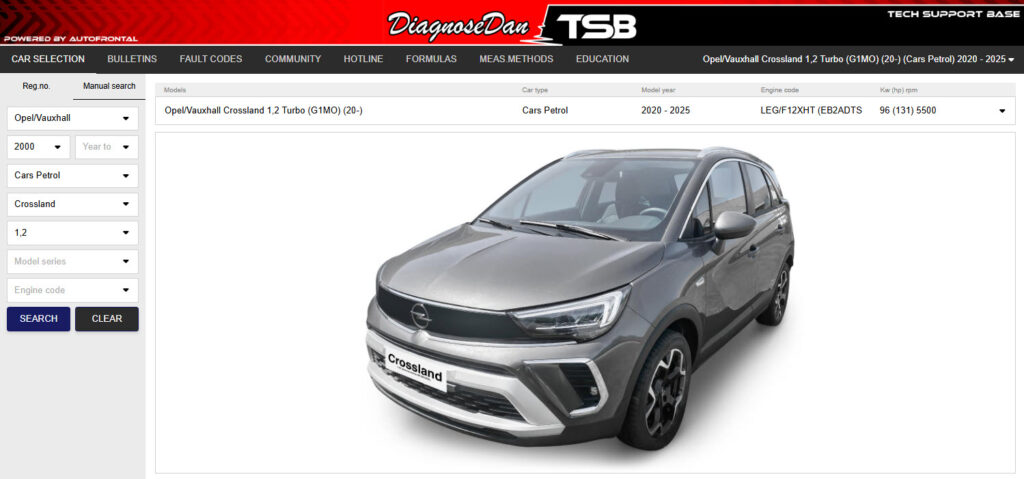
The fault can affect PSA, Opel and Vauxhall models fitted with the 1.2 PureTech EB2ADT engine, as well as related applications including the Fiat Doblo and Toyota Proace City.
What the workshop may experience
The engine may take longer than normal to start, run very poorly once started and, in some cases, only manage to idle. The following fault codes may be stored:
- P0001 13 – Control of the High-pressure Fuel Flow Regulator: Open Circuit
- P0002 92 – Control of the High-pressure Fuel Flow Regulator: Performance or Operation Does Not Conform
- P0612 92 – Engine Management ECU: Performance or Operation Does Not Conform
There is an important detail here: P0612 92 must be stored together with P0001 13 or P0002 92 for this bulletin to apply. If the engine runs normally and P0612 92 is the only fault stored, a different diagnostic route is required.
Why the engine can still run with almost no high fuel pressure
When fuel pressure is checked in live data with the engine running, the measured rail pressure may remain at only 5–6 bar. This is effectively the low-pressure supply delivered by the in-tank fuel pump, not the pressure that should be generated by the high-pressure pump.
The explanation is found in the design of the high-pressure fuel regulator. In its de-energised state, the regulator remains open, allowing the low-pressure fuel supply to pass through the high-pressure pump and reach the rail. The engine may therefore start and idle badly even though the regulator is receiving no control signal.
This behaviour can easily direct the diagnosis towards the high-pressure pump or its regulator. However, several workshop cases have shown that the real problem can be the output stage inside the engine ECU responsible for controlling the regulator.
The measurement that supports the ECU diagnosis
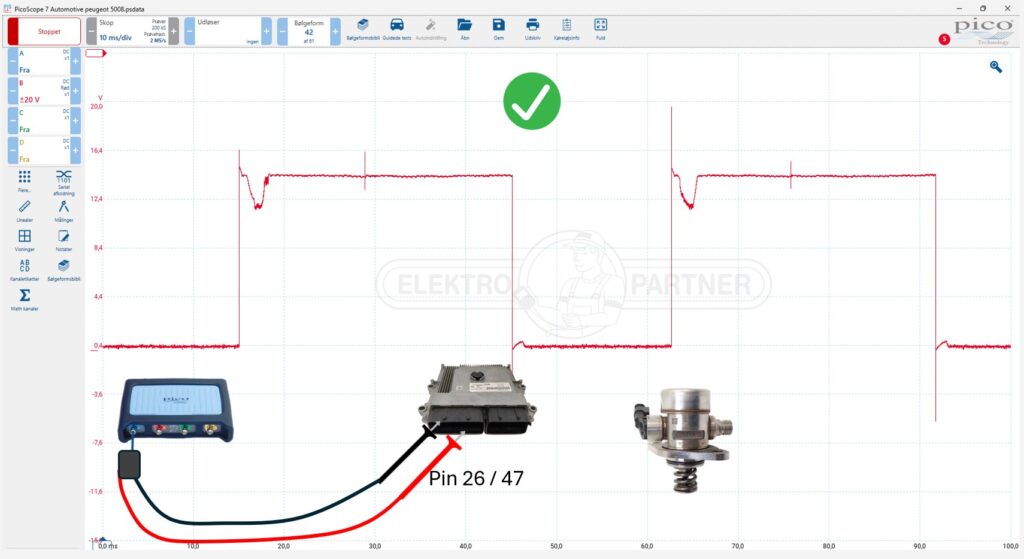
The decisive test is to check the PWM control signal from the engine ECU to the regulator in the high-pressure pump with both connectors fitted.
The bulletin includes two useful reference measurements:
- A faulty example where the rail pressure remains at 5–6 bar and no PWM control signal is produced by the ECU.
- A known-good example showing the correct PWM signal from the ECU to the regulator.
Having both examples makes the decision far more defensible. The technician is not condemning the ECU simply because a fault code mentions it. The diagnosis is supported by the actual fuel pressure and by a direct comparison between the missing control signal and a known-good waveform.
Do not order the ECU before completing this check
Even with these measurements, the engine ECU must remain the final suspect rather than the first.
Before replacement, check:
- The connections in the wiring between the ECU and the high-pressure fuel regulator.
- Connector condition at both components.
- The pin grip at the ECU and regulator terminals.
Only when the wiring, connectors and terminal contact have been verified, the rail pressure remains at approximately 5–6 bar and the ECU still produces no PWM control signal is there strong evidence that the ECU output stage has failed.
A known Continental VD56 ECU concern
The manufacturer has identified a possible production fault affecting Continental VD56 engine control units installed in vehicles manufactured between December 2023 and May 2025. However, DDTSB hotline cases indicate that the same failure can also occur on vehicles produced outside this period.
If the ECU is confirmed faulty, it must be replaced and coded to the vehicle. Coding may be possible through Remote Diagnostics, but a used engine control unit cannot be coded for this application.
This is exactly the type of repair where good reference data matters. Replacing the ECU without proof is an expensive gamble. Having the correct pressure reading, the expected PWM waveform and a clear list of wiring checks gives the workshop a far more reliable basis for making the final decision. This is DDTSB No. 13507.
✅ Polestar 2 No Ready Mode After 12-Volt Battery Discharge – Could One Reset Procedure Solve Dozens of Communication Faults?
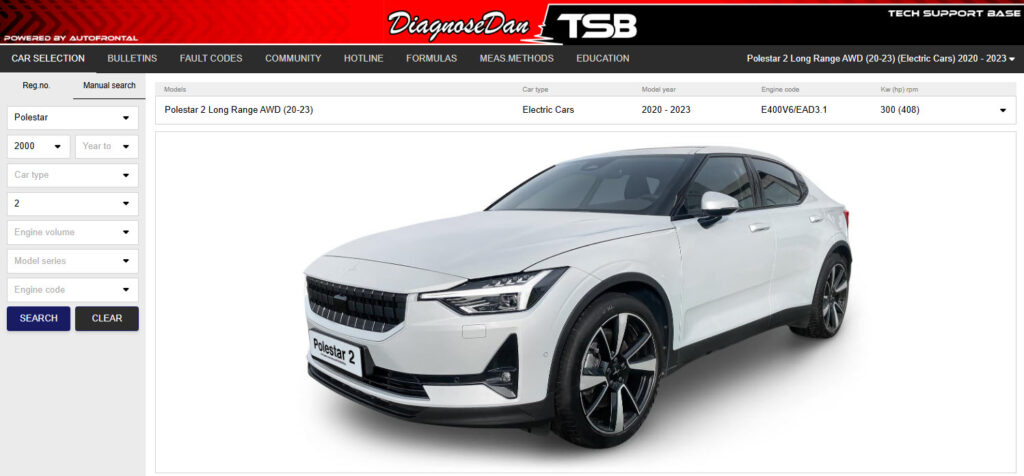
A discharged 12-volt battery can have many different causes. However, on a Polestar 2, it can trigger a symptom that technicians may encounter in several different situations: the battery has been recharged, but the vehicle still refuses to enter Ready mode.
Several warning indicators may remain illuminated, and a full vehicle scan can produce a long list of communication faults involving control units across the car. The immediate suspicion may be a faulty module, but which one? When the scan reports lost communication with the engine control module, Vehicle Dynamics Domain Master, steering angle sensor and several other systems at the same time, the diagnosis can quickly turn into hours of testing without a clear direction.
This issue has now been seen repeatedly. The good news is that the solution often requires no replacement parts. The key is knowing the exact reset procedure needed to restore communication on the CAN bus and FlexRay network.
What the workshop may experience
After the 12-volt battery has discharged, the Polestar 2 may show the following symptoms:
- The vehicle will not enter Ready mode even after the 12-volt battery has been recharged.
- Several warning indicators remain illuminated.
- Communication with multiple control units is missing or interrupted.
- A large number of apparently unrelated fault codes are stored.
Typical examples include:
- U010092 – Lost Communication With Engine Control Module (ECM)
- U101092 – Lost Communication With Vehicle Dynamics Domain Master (VDDM)
- U012692 – Lost Communication With Steering Angle Sensor Module (SAS)
- U101887 – FlexRay Communication Bus: Missing Message
- U112482 – Interrupted Communication With Vehicle Dynamics Domain Master (VDDM)
- U210993 – Backup Battery: No Operation
These may be accompanied by many additional communication, invalid signal and corrupted message faults across the vehicle.
When the fault-code list points in every direction
With so many control units reporting missing messages, it is easy to start looking for the one module that has brought the network down. However, the fault-code list may be showing the consequences of the network failure rather than identifying a defective control unit.
The 12-volt battery may have discharged because the vehicle was left in service mode for an extended period without a maintenance charger, but many other causes can lead to the same condition. The important point is that simply charging the battery may not bring the CAN bus and FlexRay network back online.
This is what makes the fault so misleading. The original reason for the discharged battery may be completely separate from the reason the vehicle will no longer enter Ready mode.
This is more than a normal battery reset
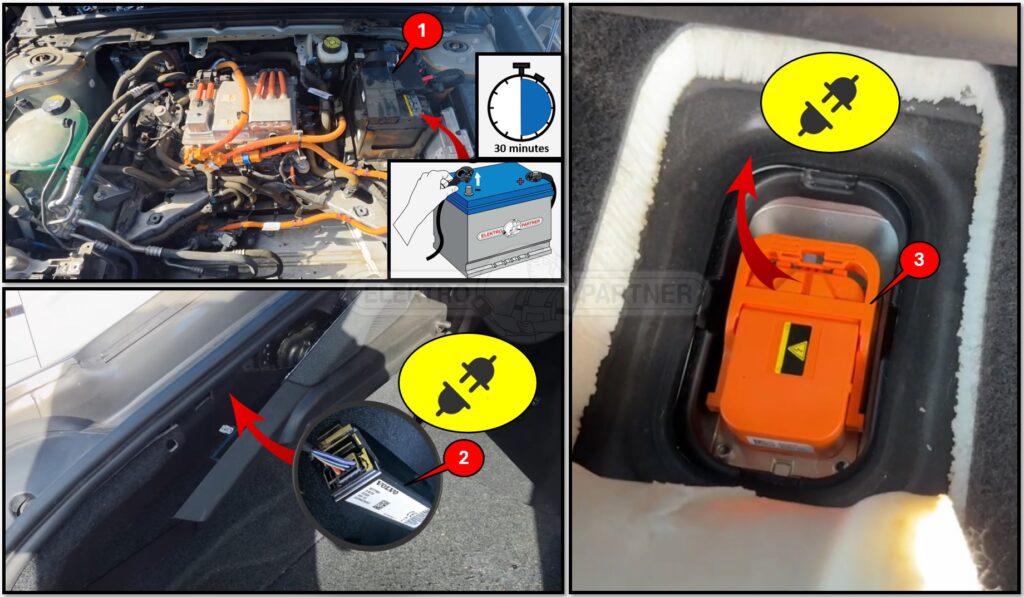
The solution is a Terminal reset procedure, which DDTSB users can now find in DDTSB No. 13537.
One fault code requires extra attention
If the main 12-volt battery has remained discharged for a long period, the backup battery for the TCAM emergency call system may also be flat.
Fault code U210993 – Backup Battery: No Operation is the important clue. If this fault remains stored in the TCAM control unit and cannot be cleared after the reset, the backup battery may need to be charged using a diagnostic tool according to the separate DDTSB procedure.
In many cases, however, no control unit has failed and no parts are required. What initially looks like a major network fault can be resolved by following the correct disconnection sequence and allowing enough time for the vehicle’s systems to reset completely.
This is a procedure worth remembering. A discharged 12-volt battery is not an unusual workshop situation, and knowing this reset can prevent unnecessary module testing, programming and parts replacement when a Polestar 2 remains stuck outside Ready mode.
This was DDTSB No. 13537.
✅ Land Rover Freelander 2 2.2 Loses Power When Hot and Stalls at Idle – No Fault Codes and a Surprisingly Basic Cause
Few faults consume more workshop time than a severe loss of engine power with no stored fault codes. There is no clear direction from the diagnostic scan, no warning lamp to follow and often no obvious component failure.
On the Land Rover Freelander 2 fitted with the 2.2 DW12BTED4/224DT engine, the vehicle may drive normally while cold but lose power once the engine and fuel system have reached operating temperature. The engine speed can drop severely when the air conditioning or other electrical consumers are switched on, and in some cases the engine may stop completely at idle.
That last symptom makes the diagnosis particularly misleading. A complete engine stall at idle is not normally the first symptom a technician would connect with the fault found in this case.
What the workshop may experience
The fault normally becomes visible only after the vehicle is fully warm:
- Severe loss of engine power.
- A significant RPM drop when the air conditioning or electrical consumers are activated.
- Poor performance under load, especially when climbing hills.
- Near-stalling or complete engine shutdown at idle.
- No warning lamps and possibly no stored fault codes.
Why normal fuel-pressure readings can be misleading
Even while the engine is losing power, the desired and actual fuel rail pressure may remain within specification. This can lead the diagnosis towards air supply, boost control, engine load or an intermittent electrical fault.
The real problem is excessive heat building up in the fuel circuit. Under these conditions, engine performance can be reduced dramatically without a warning lamp or a useful fault code to explain why.
Why the fuel becomes so hot
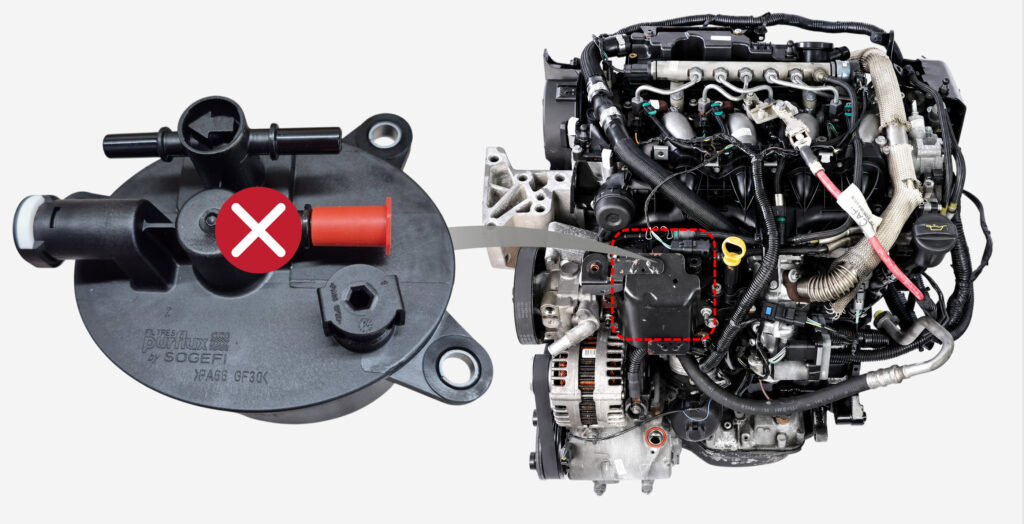
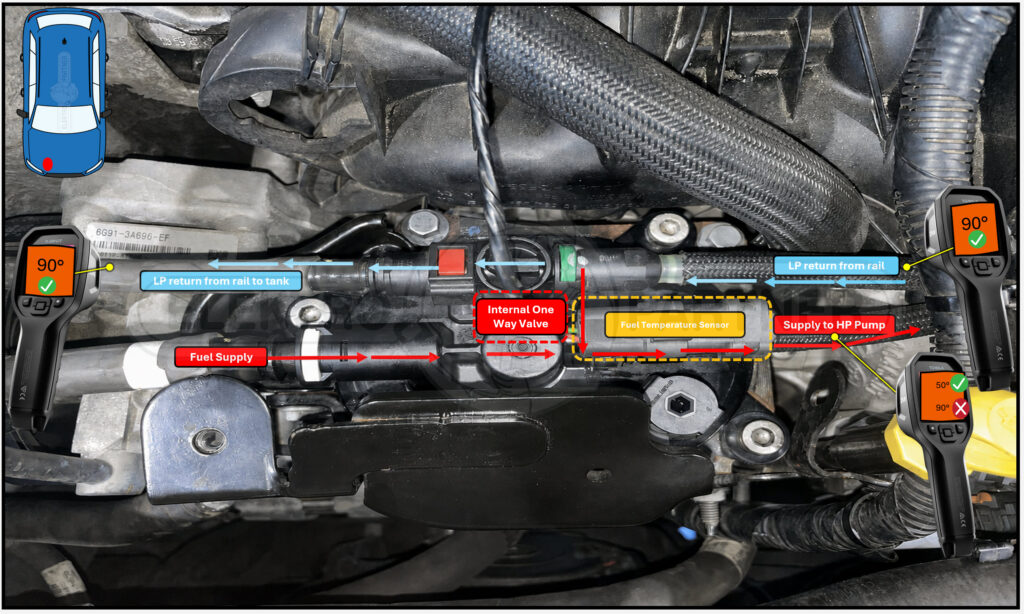
The high-pressure pump naturally adds heat to the fuel as it compresses it for the common rail system. When the engine is cold, an internal bypass valve in the fuel filter housing recirculates hot return fuel into the supply circuit. This helps warm the fuel and prevents diesel waxing in cold conditions.
Once the fuel reaches approximately 50°C, the valve should close and direct the hot return fuel back to the tank. If the valve remains stuck open, the heated return fuel continues circulating through the engine supply circuit instead. The fuel temperature then keeps rising until the ECU intervenes.
The basic component behind this dramatic symptom is therefore the fuel filter assembly rather than a major high-pressure fuel component or a complex electronic fault.
Proving the fault before replacing parts
DDTSB No. 13556 includes a practical test using temperature measurements at the fuel filter assembly. Comparing the temperature of the supply line with the return lines makes it possible to determine whether the internal bypass valve is routing the fuel correctly.
This comparison gives the workshop a practical way to confirm whether hot return fuel is being directed back to the tank or incorrectly recirculated into the supply circuit.
If the fuel filter assembly is confirmed as the cause, it should be replaced with an OEM-quality or premium-tier aftermarket component. The case shows how a relatively basic service component can cause symptoms that initially look like a much more complicated engine-management fault.
Finding TSBs in DDTSB When No Fault Codes Are Stored
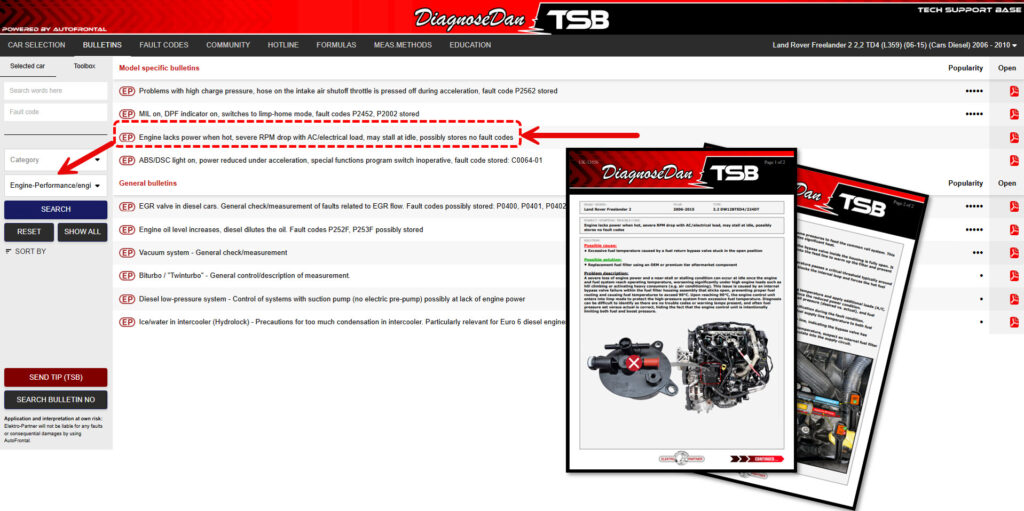
When a vehicle has no stored fault codes, the preselected symptom filters in DDTSB are a great way to find TSBs covering similar problems.
A keyword search can also be used, but selecting a preselected symptom will often produce a cleaner and more focused list of results related to the actual customer complaint.
This was DDTSB No. 13556.
Want more real life cases?
If you enjoy stories like these and want to see the work that goes on behind the scenes at DDTSB, make sure to subscribe to our new YouTube channel. There we share more case stories, diagnostic tips and repair insights straight from the workshop floor.
https://www.youtube.com/@DDTSB
🚀 Maximize Your Workshop’s Potential with DDTSB
Gain access to:
Thousands of exclusive aftermarket TSBs
Real-world fixes from one of Europe’s largest hotline centers
Faster diagnostics, smarter repairs, and higher profitability