

🔧 Nouvelles fiches techniques (TSB) mises en ligne – juin et juillet 2025
Gardez une longueur d'avance avec les derniers bulletins techniques (TSB) publiés au cours des deux derniers mois.
-
209 TSB tout nouveaux
-
197 mises à jour de bulletins existants
Chaque cas s'inspire d'appels réels reçus par l'un des plus grands centres d'assistance téléphonique du marché des pièces de rechange en Europe. Ces bulletins abordent les difficultés quotidiennes rencontrées dans les ateliers et aident les techniciens à gagner du temps, à établir des diagnostics plus précis et à améliorer leur efficacité.
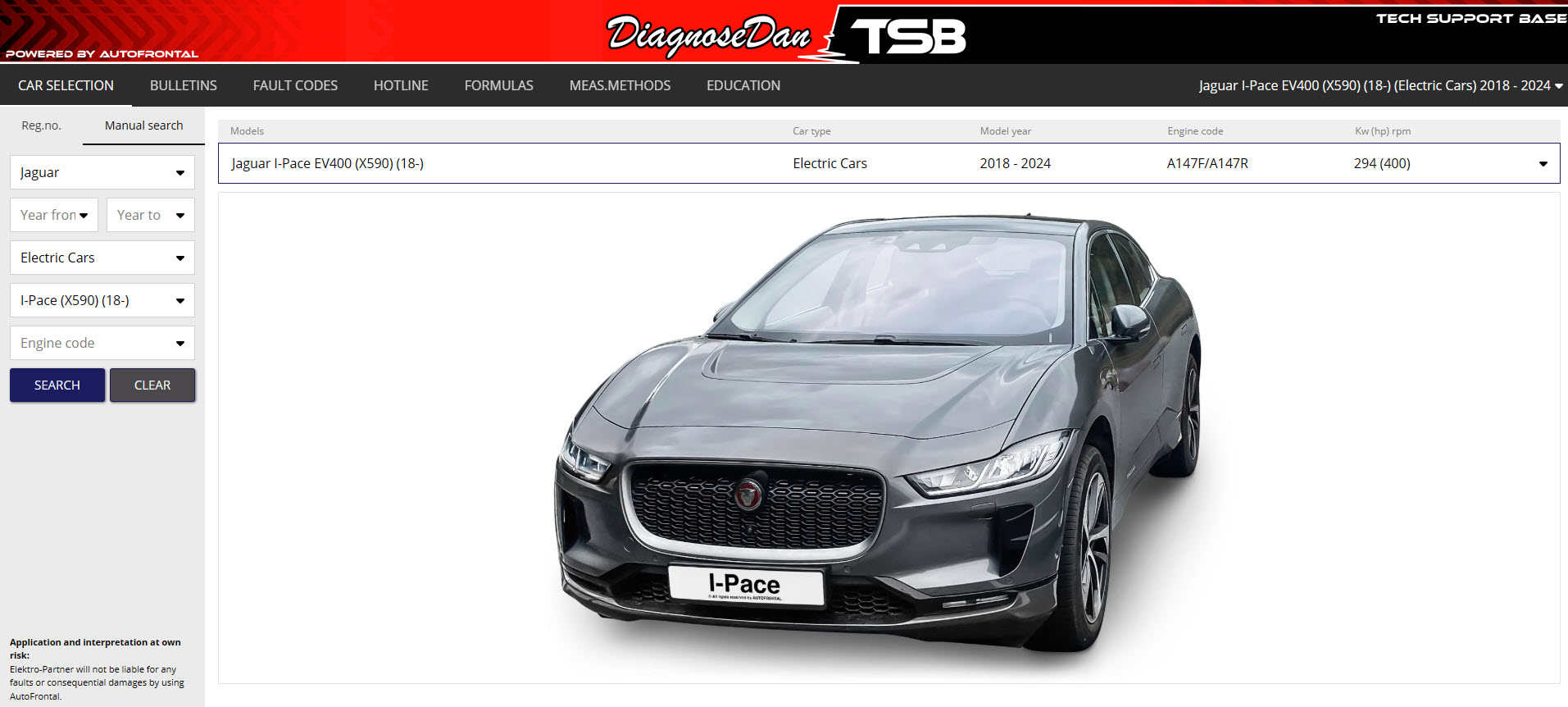
🚗 Exemple n° 1 : Jaguar I-Pace (2018-2024)
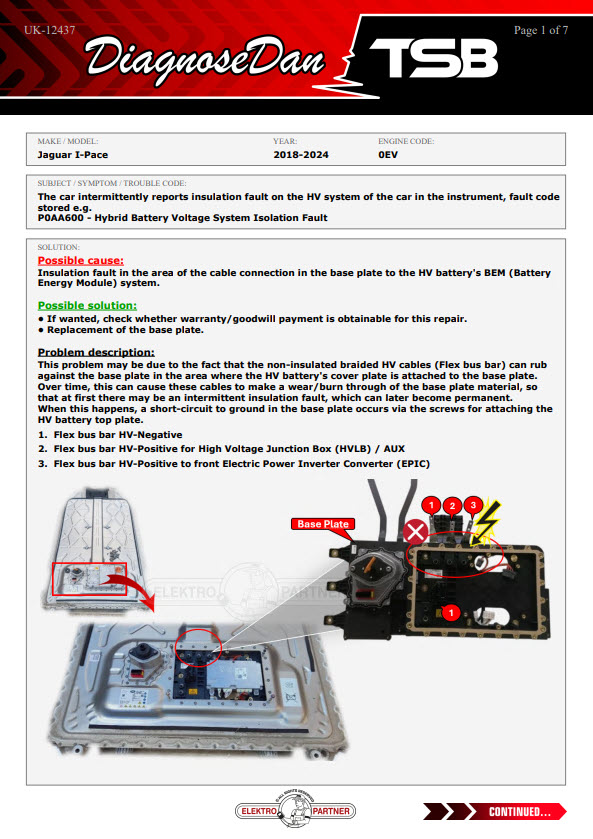
TSB n° 12437
Le propriétaire d'une Jaguar I-Pace était confronté depuis des mois à un problème d'isolation intermittent. Le Code d'erreur P0AA6 de la Jaguar I-Pace Cela a compliqué le diagnostic, car l'importateur a refusé de prendre en charge la garantie, affirmant que le problème ne provenait pas de la batterie haute tension. Plusieurs garages indépendants ont contesté cette affirmation, insistant sur le fait que le problème était d'origine interne. Faute de preuves tangibles, le client s'est retrouvé dans une impasse.
Un client dans une impasse
Plusieurs ateliers indépendants ont émis un avis contraire, affirmant que le problème provenait de l'intérieur de la batterie. En l'absence de consensus et de preuve formelle, le client se trouvait dans une impasse. La seule solution consistait à ouvrir la batterie, une opération longue et coûteuse. Et si l'importateur s'avérait avoir raison, la facture serait à la charge du client.
Comportement inhabituel du relais
On pouvait entendre les relais haute tension situés à l'intérieur de la batterie cliquer en s'ouvrant et en se fermant alors que la voiture était à l'arrêt et que le message d'erreur était actif. Lorsque l'on appuyait sur l'accélérateur, les relais se fermaient et la voiture pouvait rouler, mais ils s'ouvraient à nouveau dès que l'on relâchait la pédale. Dans le même temps, la voiture a enregistré le code d'erreur P0AA6 « Défaut d'isolation du système de tension de la batterie hybride ».
Comme le problème se produisait très rarement, les données en temps réel sont devenues indispensables. Les techniciens ont vérifié si la charge de la climatisation, le chauffage de l'habitacle ou l'activation du moteur déclenchaient l'erreur. Dans ce cas précis, le dysfonctionnement survenait de manière totalement aléatoire : une fois pendant la conduite et une fois alors que la voiture était à l'arrêt dans l'atelier.
Utilisation de données en temps réel pour détecter les défauts d'isolation
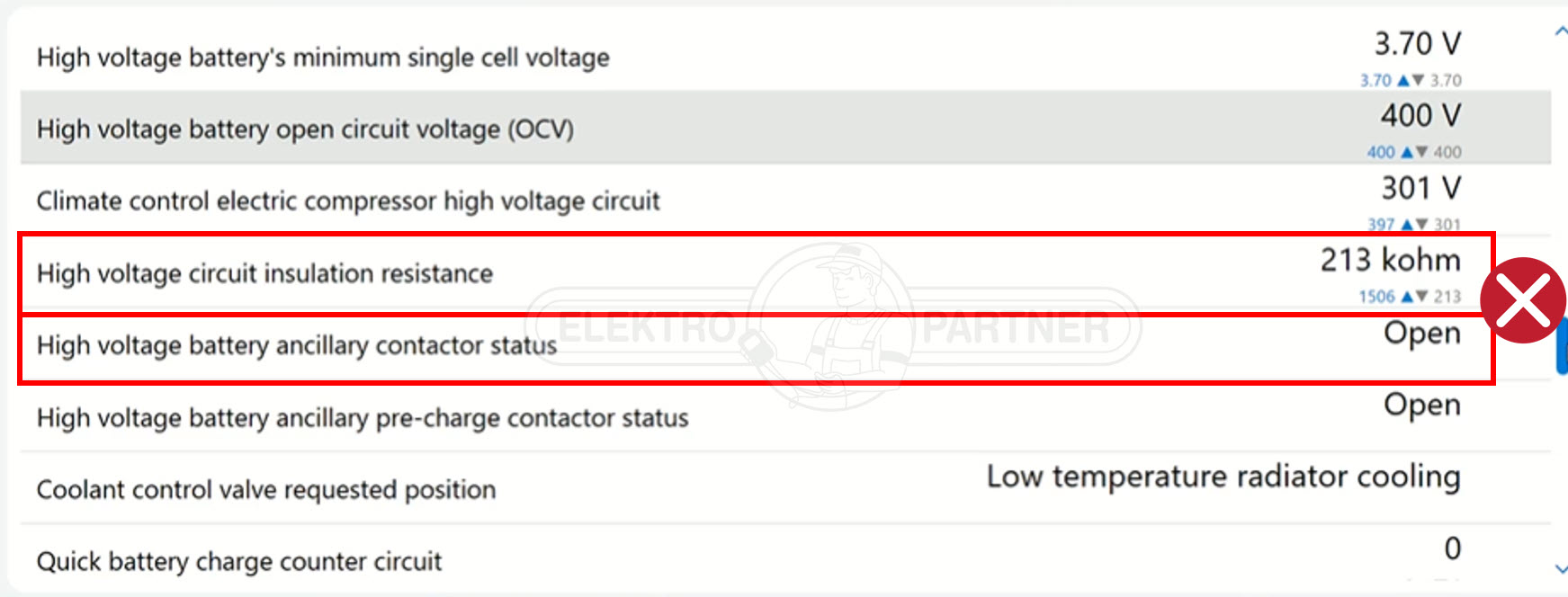
Les données en temps réel constituent un outil précieux dans ce genre de situation. Chaque véhicule électrique dispose d’un seuil à partir duquel il signale un défaut d’isolation. En surveillant ces valeurs, les techniciens peuvent déterminer avec précision à quel moment la Jaguar a décidé de déconnecter la batterie.
Rappel important : La résistance d'isolement affichée sur le testeur de diagnostic ne correspond qu'à la valeur globale du véhicule et ne peut pas être comparée directement aux valeurs mesurées à l'aide d'un mégohmmètre sur un composant individuel. Plusieurs petites fuites réparties sur différents modules peuvent, cumulées, donner lieu à une valeur de mesure faible qui masque la véritable source du problème.
Sur cette Jaguar, le technicien a constaté une faible résistance même lorsque le système haute tension était déconnecté et les contacteurs ouverts. Cela indiquait clairement que le défaut se situait à l'intérieur de la batterie plutôt que dans le câblage externe, ce qui nous a permis de concentrer nos recherches au bon endroit.
À quoi ressemblait cette faute dans la pratique ?
La voiture a enregistré de manière intermittente le code d'erreur P0AA600 : « Défaut d'isolation du système de tension de la batterie hybride ». Chaque fois que la résistance d'isolement tombait à environ 213 kΩ, les relais s'ouvraient et la batterie se déconnectait.
L'affaire a été transmise
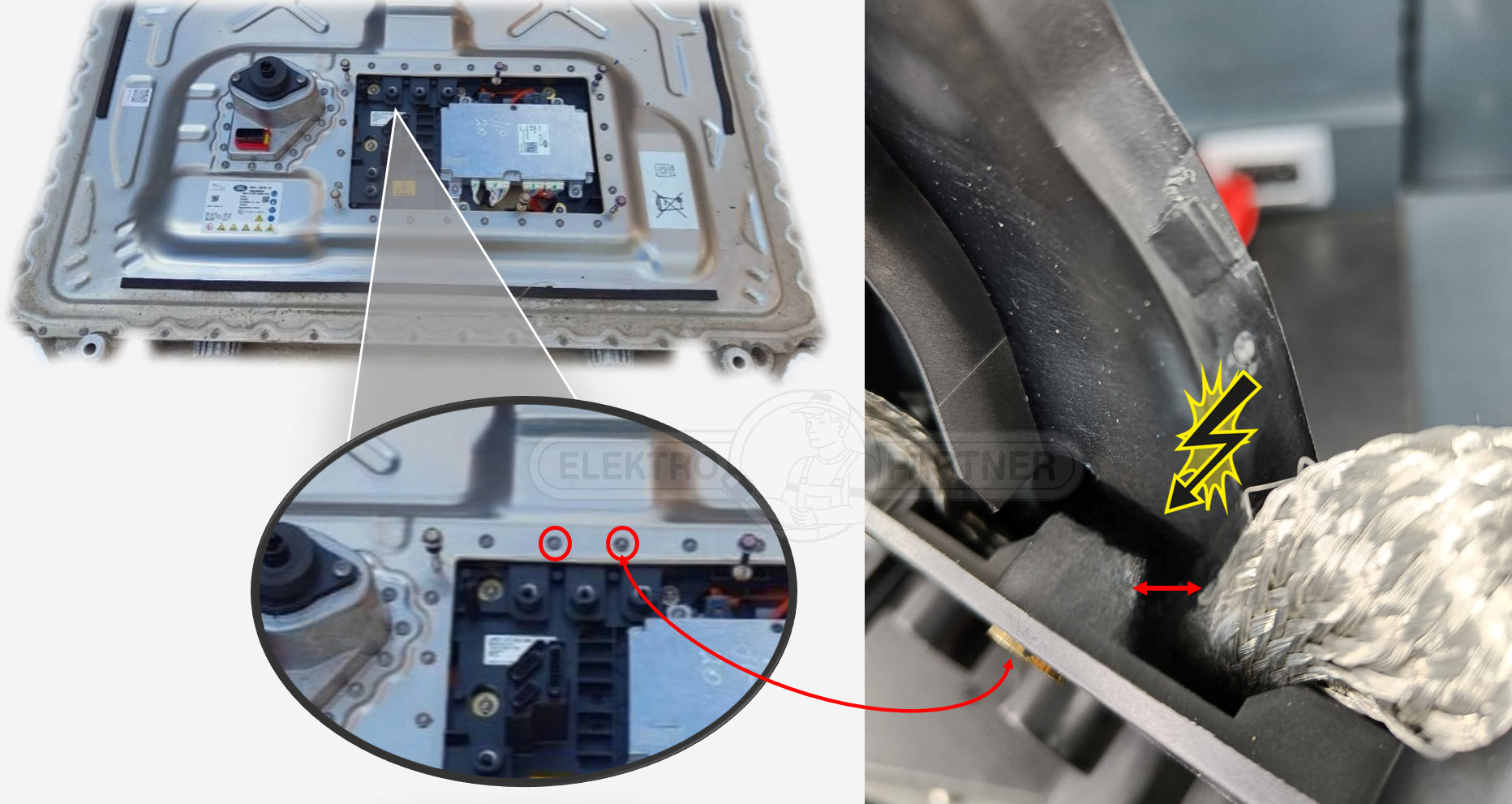
La voiture a finalement été confiée à un organisme d'inspection indépendant, capable d'effectuer des analyses plus approfondies qu'un garage classique. Celui-ci a démonté la batterie haute tension et a finalement pu mesurer et mettre en évidence la panne. La cause était claire : des barres omnibus flexibles haute tension non isolées avaient frotté contre la plaque de base et, au fil du temps, cette usure avait provoqué des courts-circuits à la masse au niveau des boulons fixant le couvercle de la batterie.
Problèmes liés aux réparations et à la garantie
Sur le papier, la réparation est simple. Il faut remplacer la plaque de base de la batterie haute tension (référence T4K14339 / J9D310J714AB). Dans la pratique, l'opération s'avère bien plus compliquée.
La prise en charge des frais au titre de la garantie ou à titre commercial dépend de la politique locale et de la manière dont l'importateur interprète le défaut. S'il estime qu'il ne s'agit pas d'une véritable défaillance interne de la batterie, le client et le garage peuvent se retrouver avec une facture salée. Pour les garages indépendants, cela rend la procédure à la fois longue et risquée.
Pourquoi cette affaire est importante
Le cas de la Jaguar I-Pace P0AA6 illustre à quel point les défauts d’isolation peuvent être complexes. Ils apparaissent de manière aléatoire, sont pratiquement impossibles à reproduire à volonté et échappent souvent aux outils de diagnostic d’origine. De plus, le plus grand défi ne réside pas seulement dans l'identification de la cause première, mais aussi dans la détermination de la partie qui doit prendre en charge les frais de réparation, y compris les frais de diagnostic. Au final, seuls des tests approfondis et une collaboration entre les ateliers et les organismes indépendants offrent au client une chance équitable d'obtenir une solution adéquate.
Remarque concernant les personnes autorisées à ouvrir la batterie
Selon les informations fournies par le fabricant lui-même Autorisation de travail Conformément à la réglementation, le personnel des concessionnaires Jaguar n'est pas autorisé à réparer ni à démonter l'intérieur d'une batterie haute tension. Cette restriction est imposée par le constructeur et limite les interventions autorisées aux techniciens des concessionnaires. Par conséquent, les ateliers doivent faire appel à un expert agréé si ce type de réparation s'avère nécessaire.
Le paradoxe réside dans le fait que, dans certains pays, les garages indépendants disposant d’une formation et d’une certification adéquates en matière de haute tension sont autorisés à aller plus loin. Ils peuvent légalement ouvrir le bloc-batterie à des fins d’inspection et de réparation. En d’autres termes, une intervention que les ateliers des concessionnaires ne peuvent pas effectuer avec leur personnel habituel peut être réalisée par un spécialiste indépendant qualifié. Cela nous rappelle que les règles varient considérablement selon le marché ou les politiques propres à chaque constructeur.
Voici la page 1 sur 7 :
🚗 Exemple 2 : PSA / Opel / Toyota – Réinitialisation de l'adaptation du turbo
TSB n° 12380
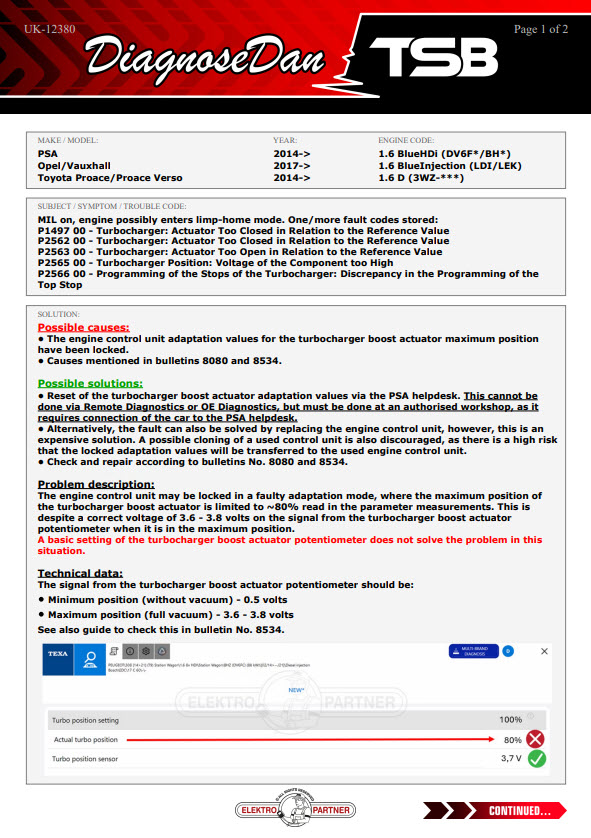
Cette affaire met en évidence une situation frustrante Défaut de l'actionneur du turbo sur la Peugeot P1497. Un véhicule équipé d'un système PSA nous a été amené en raison de problèmes récurrents liés à la position du turbo. Même après avoir remplacé le turbo et la vanne à dépression, les codes d'erreur P1497 et P2562 continuaient d'apparaître. L'atelier a soupçonné que le processus d'adaptation de l'ECU lui-même était bloqué.
Un problème frustrant pour lequel il n'existe pas de solution simple
Un garage a rencontré des difficultés avec un véhicule équipé d'un système PSA qui présentait des problèmes récurrents au niveau du capteur de position du turbo. Le turbo et la soupape à dépression avaient déjà été remplacés, mais deux nouveaux codes d'erreur continuaient d'apparaître : P1497 et P2562.
Des cycles d'adaptation avaient été tentés avec plusieurs testeurs du marché secondaire, mais les erreurs réapparaissaient presque immédiatement, souvent au ralenti. Les données en temps réel révélaient un écart : la valeur de référence restait à 87% tandis que la valeur réelle oscillait autour de 79%. Le garage soupçonnait que le processus d'adaptation lui-même n'était pas effectué correctement.
Premiers contrôles
Le chargé de la ligne d'assistance a guidé les participants à l'atelier à travers les notions de base habituelles :
-
Vérifier la tension du potentiomètre du turbo (0,5 V sans dépression, 3,6 à 3,8 V à pleine dépression).
-
Vérifier que le signal de retour de l'actionneur parvient bien au 100% en vide total.
-
Veillez à ce que la pression d'aspiration ne descende pas en dessous de 0,8 à 1 bar au ralenti.
-
Vérifiez les raccords des flexibles et assurez-vous que l'orifice de purge de l'électrovanne n'est pas obstrué.
Toutes les valeurs semblaient correctes. La dépression mesurée au ralenti était de 0,7 bar, la tension variait entre 0,5 et 3,7 V comme prévu, mais la position de l'actionneur n'indiquait toujours que 80% à pleine charge. Cela semblait indiquer une fois de plus que le problème provenait du processus d'adaptation.
Quand l'adaptation ne “ stocke ” pas”
En règle générale, l'adaptation s'effectue en sélectionnant Remplacement du turbocompresseur dans les réglages de l'ECU, puis en effectuant quelques accélérations à pleine charge suivies d'une décélération. Cela permet à l'ECU d'apprendre toute la plage de fonctionnement de l'actionneur.
Mais dans ce cas précis, l'ECU n'a jamais enregistré correctement la valeur maximale. Alors que les données en temps réel indiquaient clairement un signal de rétroaction de 3,7 V, l'ECU n'a enregistré qu'une position 80%. Ce décalage a déclenché les codes d'erreur.
La véritable cause mise au jour
Le collaborateur de la Hotline a fini par trouver des documents internes de la PSA confirmant ce que l'atelier soupçonnait :
Après la dérive adaptative, la valeur maximale de la position du turbo peut être limitée à environ 80% au ralenti, avec une valeur de référence proche de 99%. Même si les défauts sont effacés, l'écart persiste. Les essais sur route déclencheront alors les codes d'erreur P1497 et P2562. L'ECU verrouille le processus d'apprentissage et ne peut pas se réinitialiser de lui-même.
La solution ne réside pas dans un nouveau turbo, un nouvel actionneur ou une nouvelle soupape à dépression — et certainement pas dans un nouvel ECU à 2 700 euros. Il faut plutôt réinitialiser manuellement les compteurs de l'ECU. Le service d'assistance de PSA peut se connecter à distance via l'outil de diagnostic d'origine et désactiver le verrouillage d'adaptation.
Résultat de la réparation
Dans ce cas précis, la voiture a été amenée chez un concessionnaire de la marque, où le service d'assistance de PSA a procédé à la réinitialisation à distance. Suite à cela, l'adaptation s'est déroulée normalement, la position de l'actionneur a atteint 100% et les codes d'erreur ont disparu.
Pourquoi cette affaire est importante
Ce problème est particulièrement frustrant pour les garages indépendants. Les outils standard (y compris le testeur d'origine) ne permettent pas de réinitialiser les compteurs du calculateur ; ainsi, quel que soit le nombre de pièces remplacées ou d'ajustements effectués, les codes d'erreur réapparaissent sans cesse.
Le fait d'être au courant de ce problème peut permettre d'économiser d'innombrables heures de travail inutile et d'éviter des remplacements coûteux du calculateur. La seule véritable solution consiste à faire réinitialiser l'adaptation par le service d'assistance technique de PSA via le réseau officiel de concessionnaires.
C'est la page 1 sur 2
🚗 Exemple n° 3 : BMW i8 (2014-2020)
TSB n° 12470
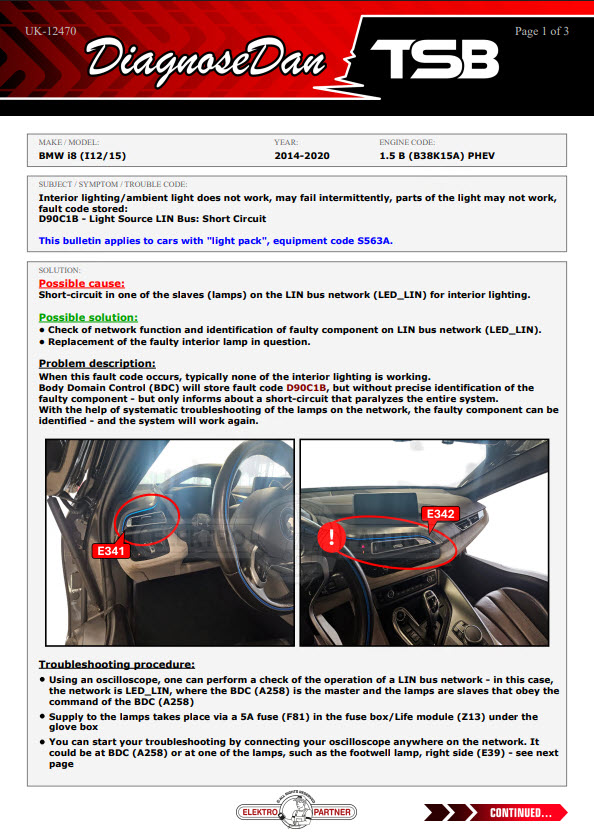
Le Panne de l'éclairage d'ambiance de la BMW i8 Ce cas illustre à quel point même un petit problème électrique peut être source de grande frustration. Un propriétaire s'est plaint que l'éclairage clignotait et s'éteignait parfois complètement lorsqu'il conduisait de nuit. Le dépannage s'est avéré délicat, car le problème était intermittent et le module de commande n'indiquait pas quelle lampe était défectueuse.
Un problème gênant la nuit
Un propriétaire de BMW i8 a signalé un problème très frustrant : l'éclairage d'ambiance de l'habitacle clignotait et s'éteignait parfois complètement lors de la conduite de nuit. Non seulement cela était gênant, mais cela détournait également l'attention du conducteur de la route. Comme beaucoup de pannes intermittentes, le problème semblait apparaître et disparaître sans schéma précis.
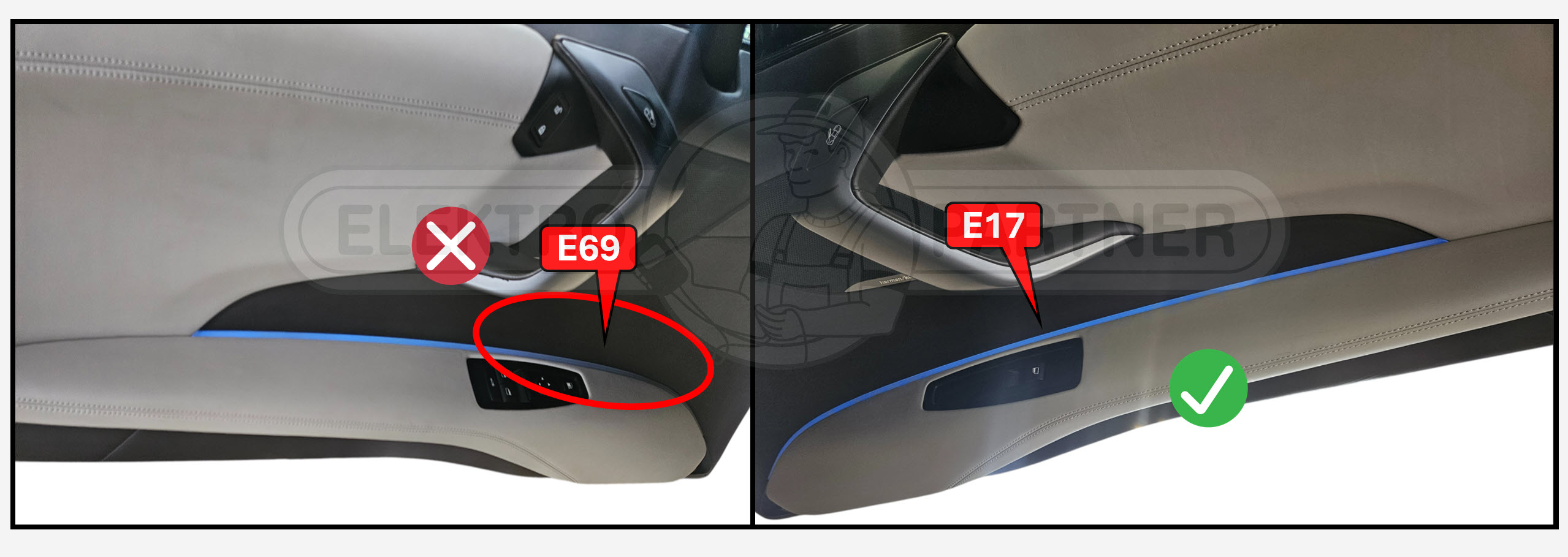
Lorsque la voiture est arrivée à l'atelier, certaines parties du pack d'éclairage intérieur ne fonctionnaient pas et, dans certains cas, l'ensemble du système d'éclairage d'ambiance était hors service. L'outil de diagnostic a affiché le code d'erreur D90C1B – Bus LIN de la source lumineuse : court-circuit.
Ce qui rendait cette faute délicate
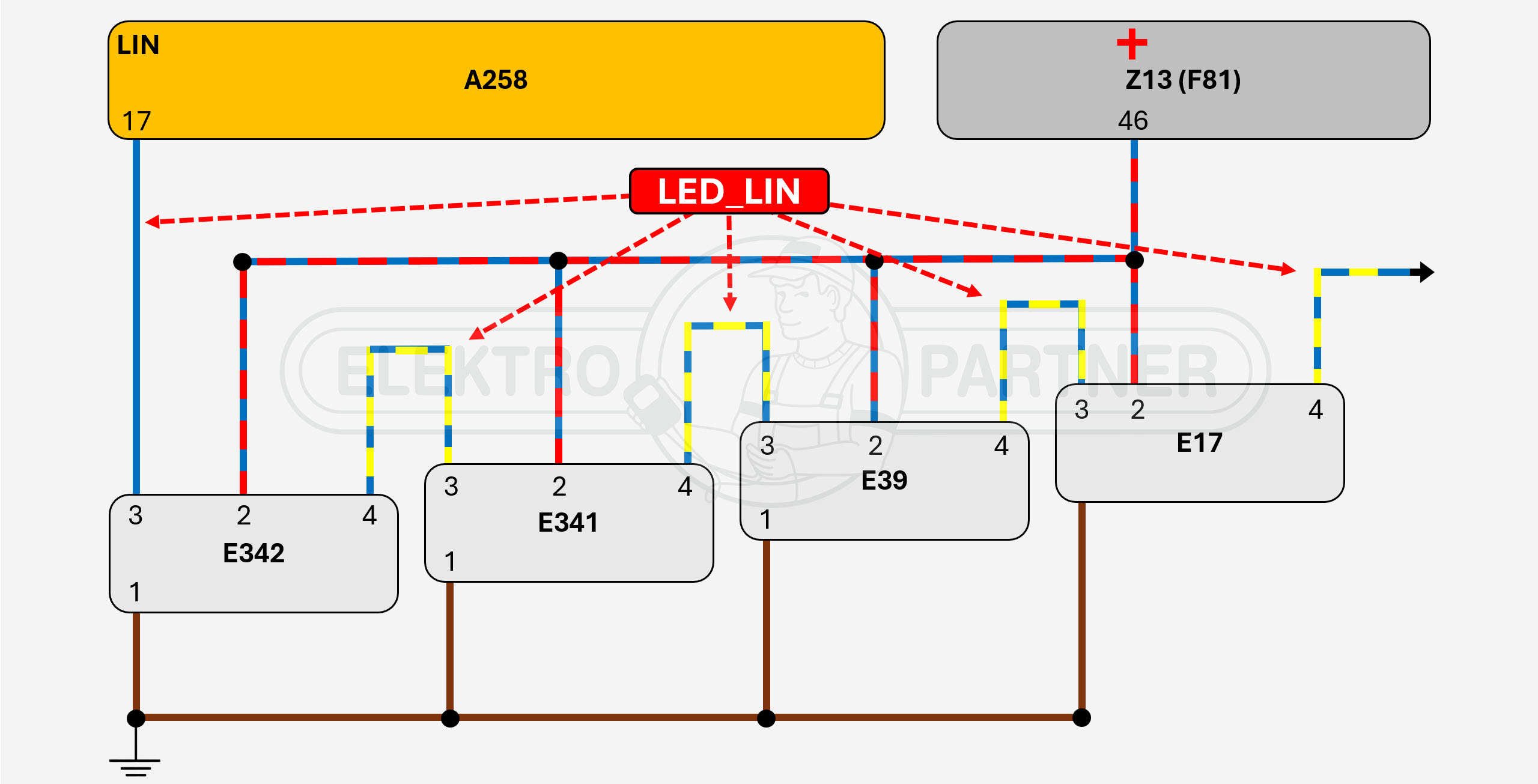
Ce modèle, équipé du code d'option S563A “ kit léger ”, utilise un réseau bus LIN (LED_LIN) pour l'éclairage intérieur. Le contrôleur de domaine de la carrosserie (BDC) fait office de maître, tandis que les lampes individuelles fonctionnent comme des esclaves sur le réseau. Lorsqu'une des lampes présente un court-circuit, l'ensemble du système peut tomber en panne.
La difficulté rencontrée lors de l'atelier tenait au fait que le BDC n'avait pas identifié quelle lampe était défectueuse. La mémoire des défauts ne signalait qu'un court-circuit général sur le réseau. Les techniciens se sont donc retrouvés face à une voiture dont tous les voyants clignotaient et à un client frustré, sans aucune indication claire.
Recherche du dépannage étape par étape
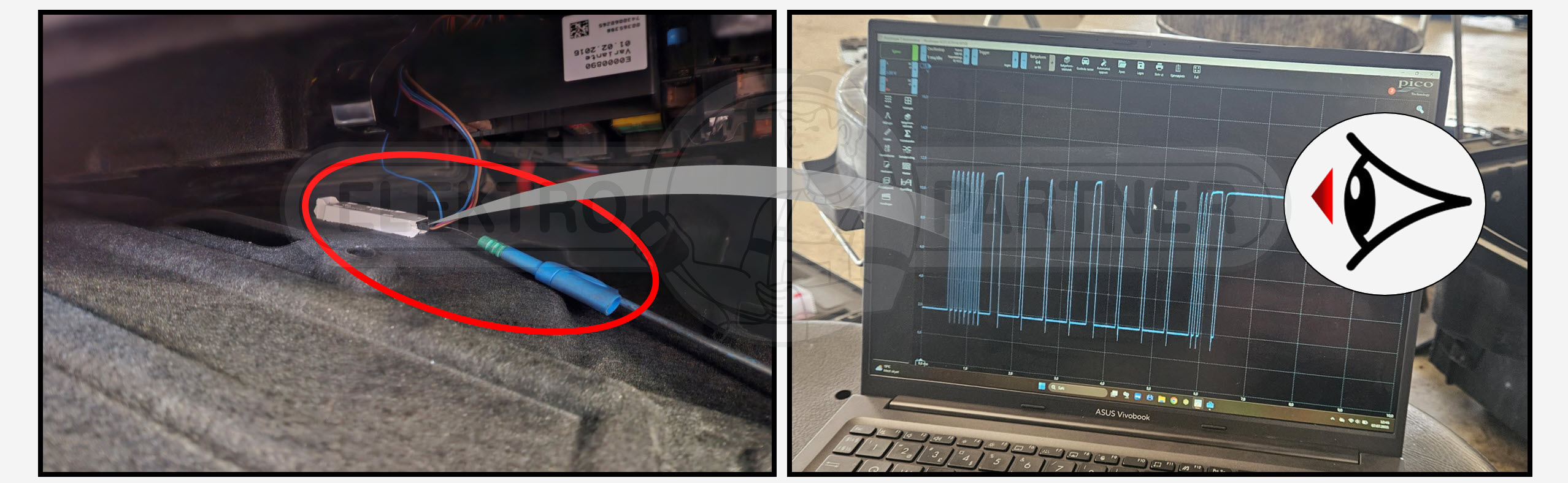
Le technicien a commencé par effectuer un dépannage systématique du réseau LED_LIN. À l'aide d'un oscilloscope, il a effectué des mesures à différents points du réseau, en commençant par le BDC, puis en passant aux lampes individuelles, telles que la lampe du plancher côté droit.
L'oscilloscope a confirmé que la communication était interrompue par l'une des unités esclaves. En débranchant les lampes une à une, l'atelier a identifié le composant défectueux à l'origine du court-circuit.
La solution et le résultat
Une fois la lampe défectueuse identifiée et remplacée, le bus LIN a repris son fonctionnement normal. Tous les éclairages intérieurs se sont rallumés, et le client a enfin pu conduire de nuit sans être gêné par des scintillements ou un éclairage d'ambiance défaillant.
Pourquoi cette affaire est importante
Cette histoire concernant la BMW i8 montre bien que même des “ petits ” problèmes, comme l'éclairage d'ambiance intérieur, peuvent être source de grande frustration pour les clients. Le bus LIN étant un système partagé, une seule ampoule défectueuse peut mettre tout le réseau hors service.
En ce qui concerne les ateliers, voici un rappel :
-
Vérifiez toujours la communication LIN directement à l'aide d'un oscilloscope lorsque les codes d'erreur sont imprécis.
-
Ne partez pas du principe que le problème vient de l'unité de commande simplement parce que la mémoire des défauts n'indique pas de lampe en particulier.
-
Demandez au client si le problème est récurrent — dans ce cas précis, il était intermittent, ce qui correspondait à la cause première.
Grâce à une approche structurée, l'atelier a évité des remplacements de pièces inutiles et a résolu un problème qui, à première vue, semblait bien plus compliqué qu'il ne l'était en réalité.
Voici la page 1 sur 3
Vous voulez découvrir d'autres cas concrets ?
Si vous appréciez ce genre d'histoires et que vous souhaitez découvrir les coulisses de DDTSB, n'oubliez pas de vous abonner à notre nouvelle chaîne YouTube. Nous y partageons d'autres études de cas, des conseils de diagnostic et des informations sur les réparations, directement depuis notre atelier.
https://www.youtube.com/@DDTSB
🚀 Optimisez le potentiel de votre atelier grâce à DDTSB
Accédez à :
Des milliers d'exclusivités avis techniques (TSB) du marché des pièces de rechange
Des solutions concrètes proposées par l'un des Les plus grands centres d'assistance téléphonique d'Europe
Des diagnostics plus rapides, des réparations plus efficaces et une rentabilité accrue